
Risks Overview
The Risk module can be used for business risks, safety and environmental risks, production risks, compliance risks, and any other type of risk you need to manage.
Add a 'Risk' to QSToolbox to do a risk assessment, and all together they make up a Risk Register that can be searched, filtered, exported. Each 'Risk' in QSToolbox is like a row in a spreadsheet risk register, but much more powerful.
QSToolbox allows you to assign responsibility for managing each risk individually, rather than having a giant spreadsheet risk register assigned to one person. Each Risk also has a due date (with reminders) for when it should be reviewed or reassessed, and you can plan and assign tasks to improve or implement new controls. To capture the whole story in one place, risks in QSToolbox can link to the procedures with your built-in controls, link to relevant equipment and competencies, link to scheduled monitoring data, and link to incident records if the risk eventuates.
This all means that when it's time to review the risk, all the relevant information is collected in one place and easily accessible.
Risk Matrix
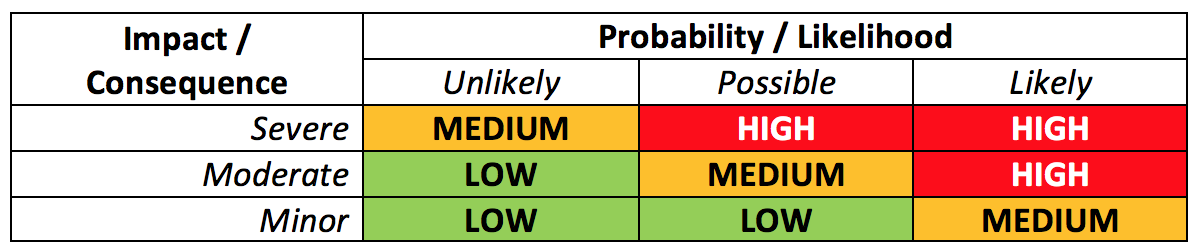
QSToolbox has a default 3x3 risk matrix, which is sufficient for many small and medium organisations, but you can replace it with your own. You can also easily customise the risk 'Types' you want to track.
Risk Management Process
QSToolbox follows a standard approach to risk assessment ( as per ISO 31000 ) :
- Establish the context
- Identify the risk
- Analyse the risk
- Evaluate the risk
- Treat the risk
- Monitor and Review
Start the process by adding a Risk.
The Risks module in QSToolbox can be used in different ways.
(1) A Risk in QSToolbox describes an individual business / quality risk.
For each risk, you describe the context in which it might arise, the causes and consequences, generate a risk rating, and describe how you control / mitigate the risk - similar to a row in a spreadsheet risk register. e.g., business cash flow risk, supply disruption risk for a critical item, sample contamination, impartiality of test personnel, project scope creep, key person risk, etc.
(2) A Risk in QSToolbox provides a summary of a detailed or specialised risk assessment.
e.g., a chemical risk assessment, for plant/equipment. A detailed risk assessment can be attached as a file, or stored as a controlled document and linked to the Risk. If it's not too complicated you can simply enter multiple possible causes and multiple controls directly into the risk in QSToolbox.
When the Risk is a summary, the risk rating entered into QSToolbox will be an overall rating, or you might prefer people enter the rating for the highest risk aspect. Your system, your choice.
(3) The Risks module is a library of your common safety and environmental risks, along with your standard controls.
Similar risks can arise in multiple situations, with the basic controls often being much the same, e.g.,
- Manual handling risks arise in incoming goods, shipping, and various production steps.
- Erosion and Sediment Runoff risk applies to many work sites,
- Transcription Error risk applies to many test procedures.
With your common risks and controls recorded in QSToolbox, the Risks module becomes a central resource to help generate new specific task-based risk assessments such as SWMS, JSAs, etc. When you improve controls for one situation, update the Risk in QSToolbox so the information is shared and captured for next time.